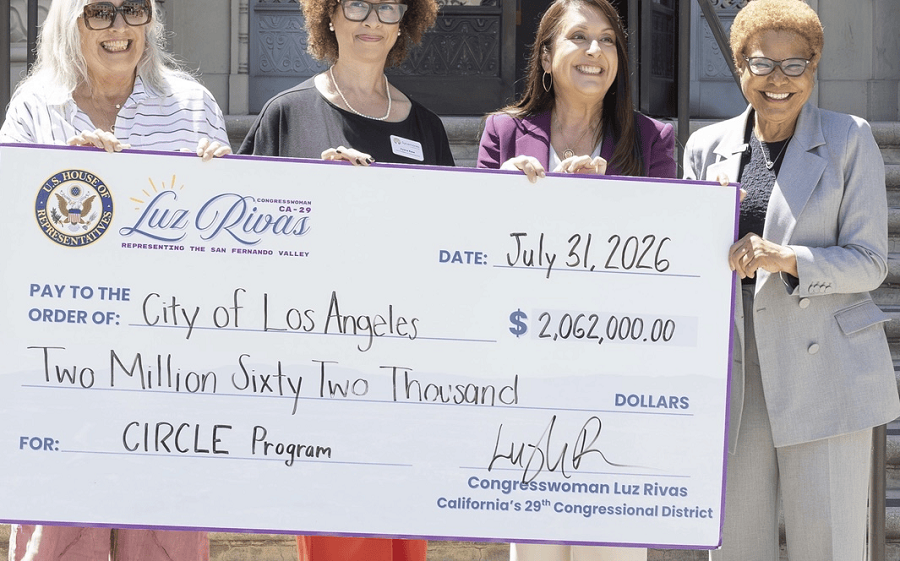
Mental health crisis teams operating in Westside neighborhoods near Santa Monica are getting reinforcements. Los Angeles Mayor Karen Bass announced Saturday, August 1, that the city secured more than $2 million in federal funding to expand its CIRCLE program, which sends trained clinicians to nonviolent crisis calls instead of police officers.
The program already covers Westside areas including Venice, meaning Santa Monica residents and those in adjacent neighborhoods can encounter CIRCLE teams responding to people in mental health emergencies. The expansion will primarily fund new hires and deepen the program's reach into the San Fernando Valley, according to the Santa Monica Mirror.
CIRCLE stands for Crisis and Incident Response through Community-Led Engagement. Run through the mayor's Office of Community Safety, it operates 24 hours a day, dispatching clinicians and peer specialists to de-escalate situations and connect people with services without law enforcement involvement.
"This federal investment will allow us to strengthen and sustain this life-changing program while ensuring our police officers can focus on the emergencies where they are needed most," Bass said at the announcement, joined by Rep. Luz Rivas (D-North Hollywood) and LA City Councilwoman Imelda Padilla.
Since Bass took office, CIRCLE has grown to cover Downtown Los Angeles, Central Hollywood, South Los Angeles, the San Fernando Valley, Westside neighborhoods, and the Harbor Area, according to the Westside Current. The outlet published a photo of a CIRCLE team conducting street outreach in Venice.
Santa Monica's own system
CIRCLE is not a Santa Monica program. The city operates its own parallel response.
The Santa Monica Police Department's Homeless Liaison Program handled 241 radio calls during the week of July 5–11 and made 90 referrals to SaMo Bridge and SaMoShel, according to SMPD's weekly recap. Homeless-related calls accounted for 24 percent of all SMPD dispositions that week. Year-to-date through July 11, those dispositions totaled 15,815, down 3.8 percent from the same period in 2025.
SMPD Chief Darrick Jacob described the department's approach in a March 10 interview with the Santa Monica Lookout, calling SaMo Bridge "an important resource" that connects individuals to mental health care, substance use treatment, housing assistance, and family reunification.
SaMo Bridge, launched in April 2025 and run by nonprofit Exodus Recovery from two trailers at the Civic Center parking lot, received 462 referrals from SMPD in its first year, far exceeding its design capacity of 260, city officials reported in a July 28 Santa Monica Lookout report. Of 363 individuals who started 90-day care coordination plans, 233 were directly connected to services, with 81 percent immediately placed into housing and treatment programs. SaMo Bridge is funded by a nearly $8 million grant from the California Board of State and Community Corrections.
The city's STEP Court, a separate diversion program, has dismissed 58 criminal cases and graduated 29 participants in two years.
Two systems, one neighborhood
The distinction matters for residents: a person in crisis on Lincoln Boulevard might be reached by a CIRCLE team dispatched through LA's Office of Community Safety, or by an SMPD officer who refers them to SaMo Bridge. No shared dispatch protocol between the two systems has been publicly documented.
Santa Monica's council voted July 28 to pursue city control of the Palm Motel for homeless services while delaying the closure of the downtown SaMoShel shelter, the latest in a series of moves to reshape the city's homelessness response infrastructure. STEP Court meets every second Wednesday of the month.