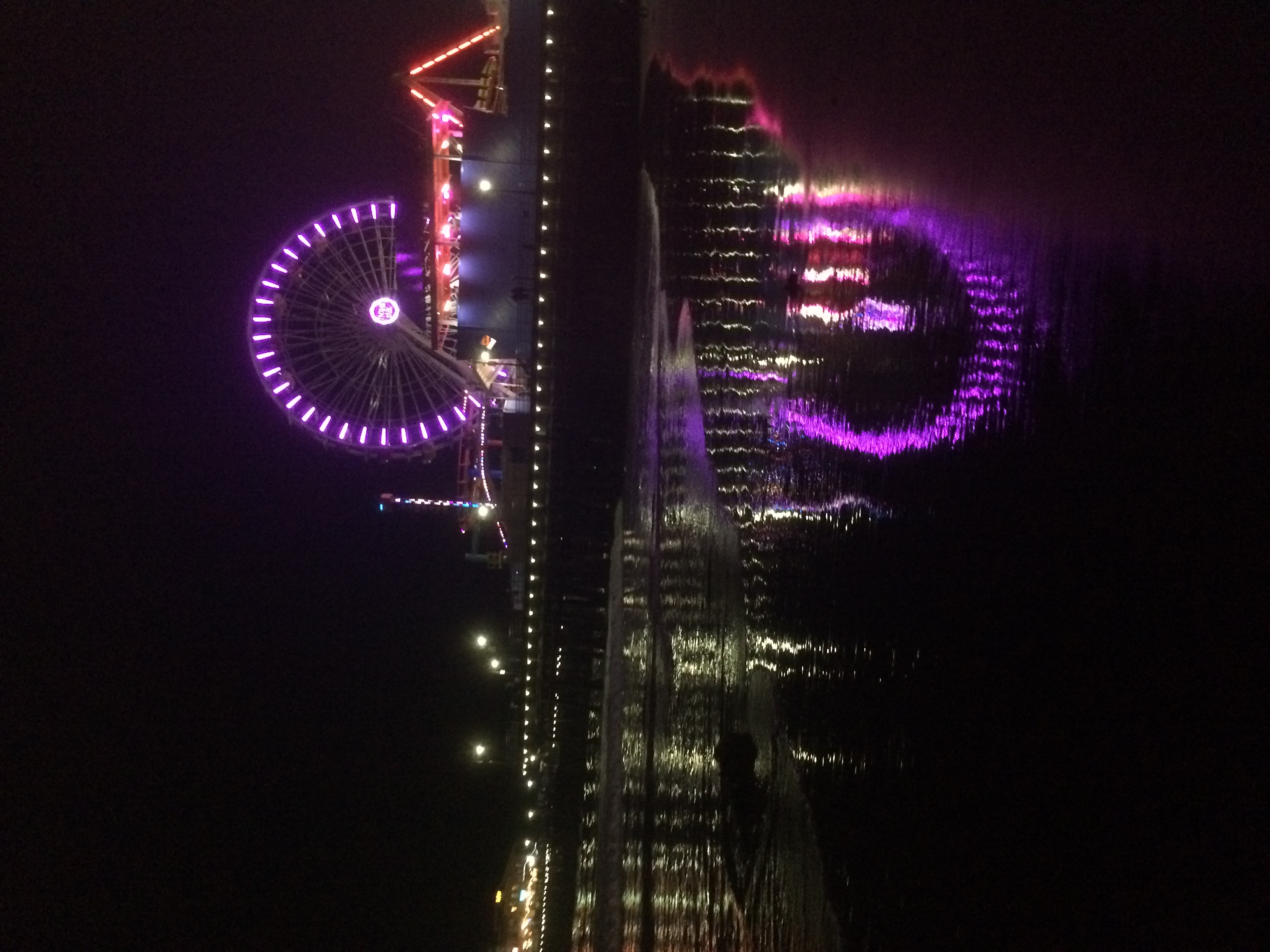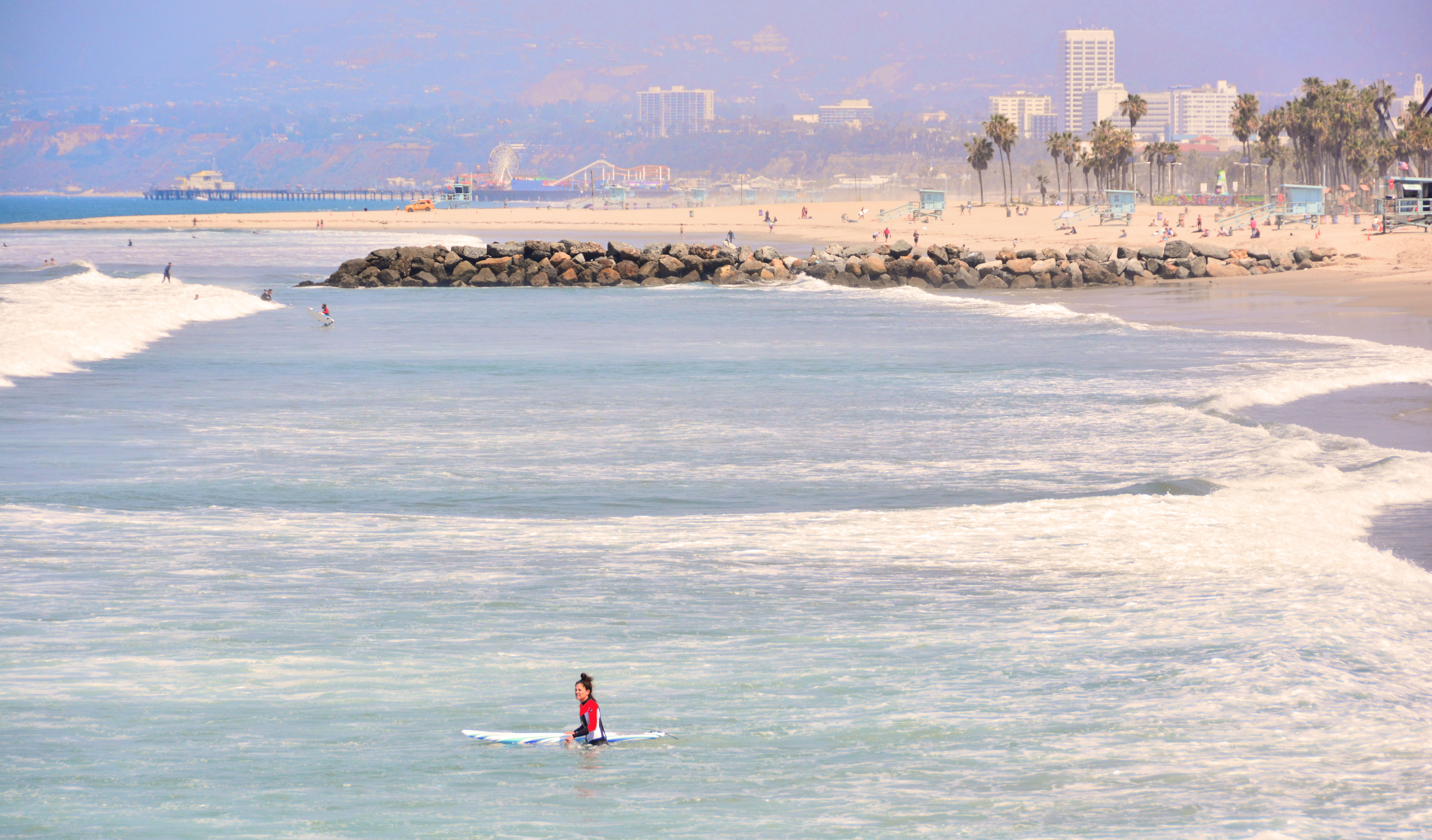
The ocean near the Santa Monica Pier will turn bright pink Tuesday, Sept. 29. UCLA researchers plan to release fluorescent dye at about 11 a.m. to study how the aging breakwater shapes currents and water quality.
The release is weather permitting, according to a city of Santa Monica press release issued Sept. 25. The pink plume may be visible from the Pier and beach for a couple of hours.
The dye is a rhodamine fluorescent water tracer, an EPA-approved substance that researchers have used for years to track water movement. It disperses naturally. It poses no risk to people, animals or vegetation, according to UCLA's Samueli School of Engineering.
Researchers from UCLA Samueli's Coastal Flood Lab are running the experiment in partnership with The Bay Foundation, a nonprofit dedicated to restoring Santa Monica Bay. The team will track the pink plume using drones, a camera mounted on the Pier mast, a remote-controlled survey boat that measures dye concentration, and instruments placed on the seafloor.
The study focuses on the breakwater, a structure built in 1934 to shelter the Santa Monica Yacht Harbor. Storms battered it over the decades, and by the mid-1980s it had been reduced to its current height. The rocky remnants are still visible from the beach at low tide.
Timu Gallien, associate professor of civil and environmental engineering at UCLA Samueli and the study's principal investigator, explained the breakwater's lasting influence when the project launched in September 2025. "Although the breakwater was badly damaged and the elevation reduced, it still substantially impacts the coastal hydrodynamics and surrounding environment," Gallien said at the time.
The team conducted four similar dye releases last fall. Three more are planned throughout October, though exact dates have not been announced.
The city of Santa Monica, the California Coastal Commission and the U.S. Army Corps of Engineers all reviewed and approved the dye releases.